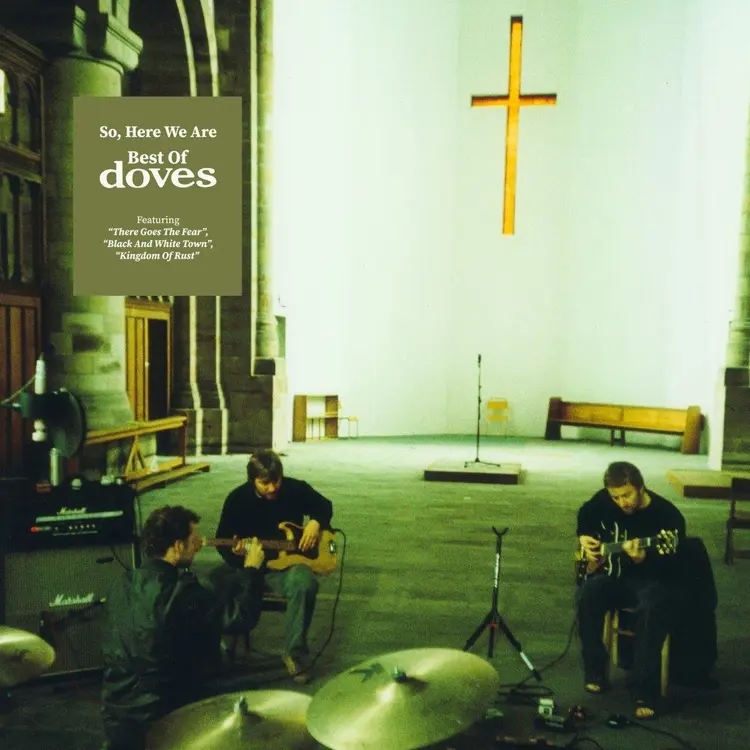
‘So, Here We Are: Best Of Doves’ was released on November 14th 2025. When the compilation was first announced earlier this year, the question was asked, “Why, another Best Of?”, which was a fair question. A quick search on the Doves’ forum on Facebook will reveal that many times over the years, it was asked by fans of the band, “why is ‘The Places Between’ Best of not available on vinyl?”. Keep asking, you shall receive, perhaps? (extended Lost Sides, anyone?) It would have been amiss to release a Best of in 2025 on vinyl without the likes of Carousels, Renegade & Lean into The Wind among other tracks released since 2010.
Here’s a track by track guide, using quotes from a recent chat I had with Andy & Jez and also some archive quotes from interviews the band did at the time of some the tracks original release. A big thank you to Tim Dorrell for the archive material.
Black and White Town Lyrics/guitar tab
Andy: It’s like when we were recording it, we were like “is this Doves?” – and that’s always a good sign. Lyrically it’s about being 15 or 16 wondering when your life’s gonna start, the romance of looking at the big city feeling like everyone else is having a good time – that naivety, something that kids in small towns understand first hand.
Jez: Initially, I thought we may have to put out Black and White Town out as a side-project, because it just wasn’t Doves. The actual title is about growing up in a small town and seeing the city on a broken black-and-white TV.
Andy: It’s more anger than nostalgia.
Jez on the comparisons with Martha Reeve’s Motown classic ‘Heatwave’: We just went with it. We’re always dropping a lot of northern soul into our music. We did a spot of DJing after we got back from touring The Last Broadcast. We played a lot of northern soul and maybe that’s how it worked its way into the music.
Jez: We had so many attempts at this track. The version we did with William Orbit was too ‘band like’ where as, I wanted a mesh of ‘band like’ and northern soul with something like The Chemical Brothers. We struggled for awhile trying to find that sweet spot with it. We knew we had a great song, so we stuck at it and eventually the time spent paid off. We used a lot of the original demo. Andy drummed over the demo which really anchored the track and from that point we added the various parts. It was like a jigsaw puzzle put together over a period of time.
Pounding Lyrics/guitar tab
Jez: When we first wrote this, it didn’t have that relentless beat. I knew the song was strong but lacked character and direction. So we sat on it for months, then once we sussed out it needed a relentless unchanging beat. A sort of primal metronome, it suddenly jumped into place.
Andy: This song was a latecomer and was the last song to be recorded for the album. Recorded at Dairy studios in Brixton with Max Heyes. I think New Order was a bit of an influence on this one. We’re still very happy to hear this getting played in the build up at Man City home games.
Snowden Lyrics/guitar tab
Jez: We wanted to do a weird 60’s musically sonic landscape to sound like early Marvin Gaye with early choral and strings and still be really edgy and menacing. It wrote itself very quickly. Funnily enough, I was recently thinking about the time we wrote the track. The place we were staying in at Snowdonia was owned by a mate of ours. It was a bit rustic, shall we say. A really dilapidated place. It barely had any electricity.
Andy: Yeah, the heating didn’t work.
Jez: Jimi’s bedroom, I swear was proper haunted. He didn’t mind it at all. He was like “Fuck it, I don’t mind a bit of that!” I thought “bloody hell”. Yeah, it was a pretty sparse place to stay. Thinking back, it was good, we got Snowden out of that place. So it was worth it for that. We then worked on Snowden up in Scotland with Ben Hillier. Then lastly recorded the strings in London. We had a 50 piece orchestra record the strings, So you can imagine all the mics set up to record this massive sound which cost thousands of pounds. But we thought it sounded too big. So we put a mic up against a speaker that would be no bigger than the stereo you have at home. The engineers thought we were mad! The recording used from that tiny speaker is what you hear on the record. We were into that lo-fi sound. We always love a sound that sounds a bit broken, out of tune (think the riff on The Fear) we’re always looking for that, rather than a big posh sound for our recordings. When it sounds like it shouldn’t really work, that’s what we find interesting.
We went back to Liverpool Parr studios to do more work on the track. Guy Garvey came in and did some lovely falsetto backing vocals. Again this vocals ended up being recorded through another speaker on a synthesizer with a mic pointing to it – another use of the low-fi sound we love.
Cold Dreaming Lyrics/guitar tab
Andy: We love David Axelrod and Rotary Connection. That was our attempt at creating a song from that era.
Jez: But hopefully with a modern twist. We’re not interested in replicating the past; we’ve always taken sonics from all sorts of places. There’s always an undercurrent of abstract atmospheres underneath the music, moving it. We were always obsessed with Northern Soul, and we wanted to write our version of a cinematic Northern Soul song. Jimi wasn’t around, so Andy and I took the vocal duties on that one We just wanted to go for a really wide panoramic, filmic sound. Lyrically, it’s all about anxiety and trying to move on from it.
Andy: Cold Dreaming’ is a song about forgiveness. Trying to forgive and move on. As a minimum, these days, resilience is the thing that you need more than ever, certainly as a musician. Perhaps the lyrics do touch a bit on what we’ve been through.
On the recycling of a previously used guitar riff, Jez adds:
It’s in three songs and it’s the same riff, although I can’t recall which one! It’s really strange, this riff, because it works in a lot of Doves songs, for some reason. What’s quite fun about it is dressing it up, where people don’t know, or don’t immediately recognize it. Some do. ‘Jetstream’ was when it was first used, and it’s resurfaced again on ‘Cold Dreaming’. Is it ‘10.03’? it’s definitely in one more.
I personally think the riff is so good we can definitely use it. I’m looking to use it in something else and hide it! Why not? The thing about music, I always think, now we’re a bit older, I literally don’t care. It’s about having the freedom to do what you want. I think we can now; I think we’ve earnt that right.
Catch the Sun Lyrics/guitar tab
Jez: Many versions of this song were recorded. We did a live session on Radio 1 for Steve Lamacq. We really liked this version and was the template to try and capture this for the record. After many failed attempts we went in with the wonderful Steve Osborne at Real World Studios for the final version. Here’s the five versions we did:
1: Original demo
2: Jacobs studio version
3: The Windings studio version
4: Radio 1 session version
5: Steve Osborne at Real World version
Andy: I can definitely hear the New Order influence in there. It almost never made the album as we could never nail the recording of it. Steve Osborne heard the Steve Lamacq session and suggested we use that as the template and not overdub (too much!) catch the energy of a live performance which we hadn’t done too much on this album up to that point, as some of the songs were constructed almost piece by piece like a jigsaw puzzle.
Broken Eyes Lyrics/guitar tab
Andy: Probably the oldest song on the album (12-15 years) we never managed to finish it before this. When we got together early 2017 we found it again on a hard drive again and loved it. We were able to finish it finally with the clarity and distance of time. We’re all big fans of The Kinks, so I guess this is our attempt at a Davies brothers vibe! It was called Cocaine Eyes right up to the 11th hour. We changed it to Broken Eyes very late on, as I guess in the end it just didn’t sit right for any of us. Hairs on the back of the neck moment in the studio when Jimi sang the last chorus where the note changes.
Jez: We decided to go to town with the string arrangement on this one. Dan Austin then had to score them into notation for the quartet. I guess this is our most straight forward song on the album.
Darker Lyrics/guitar tab
Jez: We started this one in the Ancoats studio before it burnt down. We wanted a dirty, grungy track. We finished it at New Order’s Cheetham Hill studio.
Andy: I recall wanting a track with break beat drums, without using loops. At the time, we was into Massive Attack, Tricky, those kind of artists, that definitely rubbed off on us. We loved that scene, trip-hop – you may want to call it, it’s a shite title for the genre, but you know what I mean. We were into that so we wanted to do our own version of it.
Jez: We were listening to King Tubby at the time. So that dub thing we were into as well. We were obsessed with the hypnotic thing back then. Of course, The Cedar Room was also from that time. It’s another cracking song, is Darker. I’m real proud of it. Another song we need to do more of live, but as Andy said, I’m not sure we truly nailed it live in the past. We maybe should have another go at it..
Andy: With the verses being very dark & heavy, we wanted the chorus to be melancholic with a real yearning quality. That’s the challenge, to mesh the two together which can be tough sometimes, but I think we accomplished that on Darker.
Kingdom of Rust Lyrics/guitar tab
Jez: It started off as this melody, Johnny Cash-esque idea, but now it’s almost three songs. There’s a country vibe, a 60’s filmic thing for the chorus and a loud bit.
Jimi: Tom Rowlands from the Chemical Brothers was involved from early on in an arrangement capacity. We just wanted to try working with him and it ended up he helped us nip and tuck, it were him who coined it a “Lancashire spaghetti western” and we just loved that phrase.” The song had “a country-ish shuffle beat. It’s really expansive with a wistful melody. It’s quite emotional.
There Goes The Fear Lyrics/guitar tab
Jez: I recorded the original guitar riff on my dictaphone cassette machine and decided to keep it in the recording as I wanted a “has a that sound” ! Yet again we wanted to make it have twists and turns. Keep the arrangement unpredictable /take you on a roller coaster, so to speak. We worked on that song for a long time, the recording took months to evolve. Yet again Max Heyes really put the hours in. As technology was rudimentary in those days everything took longer. If you had a crazy sonic idea, it could take weeks of cutting /programming/trial and error sort of thing to get it right.
Andy: This song changed a lot of things for us. Recorded at Revolution studios in Cheadle, Manchester. Jez’s guitar is recorded on a Dictaphone, giving it that distinctive lo-fi vibe that we love.
I have a clear memory of writing the lyrics in my front room in Chorlton. I had no proper recording gear at home at the time. I just used a tape recorder, rewinding the instrumental version all weekend and jotting down and correcting the lyrics as I went.
To be honest, remembering back, I was going through a bit of a bad patch at the time and was probably going out and indulging too much. You look to the ones you love to justify, you turned around and life’s passed you by has a sense of regret but also a lot of hope, the song still resonates for me today. Beautiful vocal from Jimi. The samba percussion at the end was by Jimi’s old friend Marc Starr and his Man City samba group. It was recorded in the stairwell at Greenhouse rehearsal rooms in Stockport (RIP!).
Renegade Lyrics/guitar tab
Andy: As a vocalist, Jimi always brings an authenticity. This was just the rough guide vocal; there are loads of imperfections on it, but he just nailed the mood of the song. That emotion is a million times more important than anything else. Musically, it feels quite dystopian. We were going for a bit of a Scott Walker vibe. There was a lyric in there about Piccadilly Circus and someone said, ‘Why don’t you change it to Piccadilly Gardens?’ To me, the song is like Scott Walker walking around Manchester in the year 2025.
Jimi: Renegade’ was the first thing that we did together for Constellations of the Lonely. In our minds, it’s got a Blade Runner-esque theme. It was inspired by the Roy Batty speech of how nothing lasts forever, you know, ‘I’ve seen things you people wouldn’t believe’.”
Prisoners Lyrics/guitar tab
Andy: This was the last song to be written/recorded for the album. Recorded in December 2019 at our studio Frank Bough III. Up-tempo Northern soul inspired but going for a classic UK pop single but with frustrated lyrics. A speaker shredding guitar solo from Jez! The song for me has a new meaning now with the current health crisis, covid 19.
Jez: I call this future northern soul.
Here It Comes lyrics/guitar tab
Jez: I had this chord sequence that looped and cycled perfectly & had a rough top line then Andy weaved the lyrics around the music. We recorded the video under the motorway bridge (where we returned for the recording of M62 song on The Last Broadcast ) the bridge is in Northenden.
Jimi: The first time we met Martin Rebelski was during the recording of this song.
Andy: For me this is our tribute to The Specials and Northern soul. I think it was the first song I ever sang all way through, everyone wanted to keep my vocal on verse which I was surprised at (and probably argued against) Jimi sang on chorus and the contrast in the different voices seemed to work. I wanted the lyrics to have an in the city/grimy feel, with, he or she being generally being up to no good but I didn’t want it to be too specific about what that person actually was up to. I think its much more interesting for people to imagine what that person might be up to.
Carousels Lyrics/guitar tab
Andy: The lyrics are about the fairgrounds of our youth in North West England and North Wales where we used to go every summer holiday. We’d go out to visit fairgrounds and arcades, off the leash, so to speak. As kids we kind of liked the excitement and danger of these places and hearing music blaring out of speakers loud. I guess it’s a nostalgic look back, but we wanted the music to be contemporary. Originally we struggled to get further with the song until Jez found the Tony Allen drum break that just bought the song back to life.
Jez: I originally wrote this in Porto City (Portugal) but in a different guise, a different key and totally different sound. I slowed it down to fit the Tony Allen drum sample. I put in some moody synth bass, from then it all seemed to click into place.
Caught By the River Lyrics/guitar tab
Andy: Great production by Steve Osborne. Recorded and mixed at Real World studios in bath. We loved being there, it was a total contrast to anywhere else we’d been and it was very cushty!
The lyrics are about one of my best friends, who at the time moved to London but his life was spiraling out of the control, drinking way too much, waking up on park benches. I was genuinely worried about him. It’s like a note to him to make him come to his senses. Still gets me this one.
Jez: Steve Osborne did a great job in keeping it minimal. You’ll hear the chime-y guitars. These were borrowed from Peter Gabriel’s collection. He owns Real World, he said try this Rickenbacker!! It turned out to be Roger McGuinn’s (The Byrds ) guitar! Defo has that Byrds sound.
Walk In Fire Lyrics/guitar
Andy: Picks up where There Goes The Fear left off. It’s got a country vibe. It concerns a mate of ours who went off the rails. The lyrics says it all.
Jez: The song is about understanding and trying to reassure someone. If drink pulls you in, it can be hard to pull yourself out. Lyrically we are more honest and open than we have been before. We’re writing about things that effect us. But when you put it out there, you feel more exposed and vulnerable.
Andy: I pushed for this one to be on the Best Of. I’m proud of this track and I know it’s a fans favourite. One of the inspirations for the track was Elvis Presley’s, ‘Suspicious Minds’.
Jez: I always think of it as the bastard child of There Goes The Fear. I loved the guitar on Elvis’s Suspiscious Minds, that countryesque, Americana vibe.
Andy: The shuffly hi-hats
Jez: The sirens!
Lean into the Wind Lyrics/guitar tab
Jimi: It’s all there in the lyrics, it’s about addiction, It’s drawn from a situation I was in at the time and, although I am inspired more by making songs about characters, this literally happened to me. Going to someone’s house, trying something and it consuming you within days. I am not ashamed of it; it’s a story of what can happen and it’s not uncommon. It happens to people every day, hopefully it’s a cautionary tale.
Andy: Jimi took the song away and came back with the first verse. There was just instant recognition that it was about some of the stuff he must have been going through. Ultimately, it had real authenticity to it, just like everything he does. In writing the second verse, all I could do was imagine what he’d been through and what he’d been feeling. Hopefully it’s a song that resonates.
Spirit of Your Friend Lyrics/guitar tab
Jez: I had a bad dose of writer’s block way back in 2005 and turned to the music immersion method to dig myself out. ‘Spirit of Your Friend’ was born out of that and, at the heart of it, my aim was to bring out a sense of yearning, really amp that up both musically and lyrically. We were really surprised to find it before getting to work on pulling together the compilation’s running order, but it needed more work to get it down from its original seven minutes. It’s about friends we have lost and those we’re grateful are still with us.
The Man Who Told Everything Lyrics/guitar tab
Andy: I think it was recorded at Jacobs. It was a kind of exercise in writing about somebody else rather than about myself/ourselves. Lyrics are about a disgraced corrupt politician who sells his story to the papers and then buggers off.
The Cedar Room Lyrics/guitar tab
Jimi: Andy’s harmonica playing slowed down for the intro. A song of experience.
Andy: Recorded and mixed at our studio on a new mixing desk that we bought thanks to a Sub Sub remix we did for the 90’s US pop group Color Me Bad (they rejected the mix!). It was another key track for us early on. It gave us a lot of confidence to go on and finish the album. I think we sensed it was a bit special. I remember we slowed the drums down to give it that chunky feel, a rib rattler! I had a book of short ghost stories as a kid and there was one chapter called The White Lady about an old inn where the ghost would come to visit guests in the dead of night. The story really spooked me as a kid and i always remember the room where the haunting took place: the cedar room.
Later on I found out the house was just a BMX bike ride away from where we lived, so off i went to visit. I would just look at the house imagining that room and smoke a fag! Jimi wrote the chorus lyrics and I wrote the verse lyrics separately, but bizarrely they both fitted in terms of a feeling of loss and to be haunted by a memory.
Jez: Musically I wanted this to be an epic landscape with enough space to lose the listener in. We wanted to mix electronic drones to capture the strangeness and hopefully the heart of the song. I was listening to Aphex Twin at the time, so maybe some of that indirectly rubbed off.
So, Here We Are: Best Of Doves is out now on EMI North records. Listen or order a copy now.